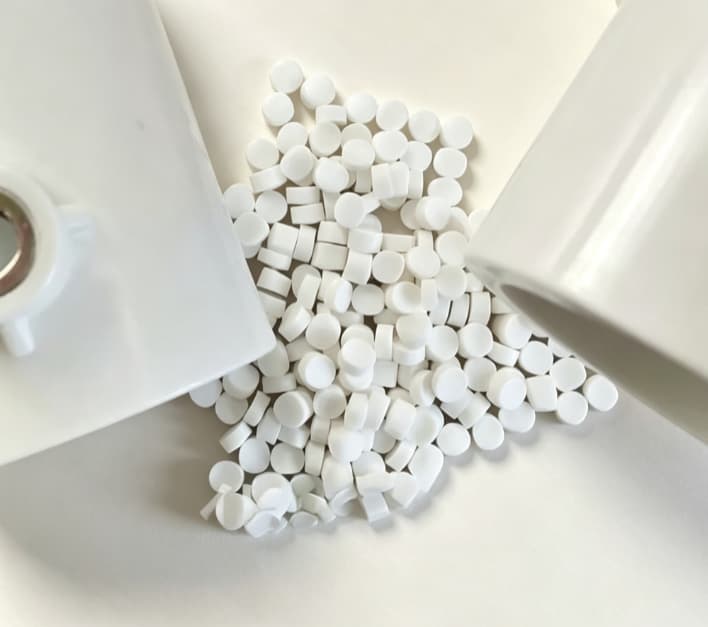
Long-term clarity depends on how the PVC compound is formulated, processed, and used. The base resin provides the foundation for transparency, while heat stabilizers, UV protection, additive compatibility, and processing conditions all influence how well the material retains its optical properties over time. This article explains the main factors behind long-term clarity, where standard PVC compounds may fall short, and what buyers should consider when specifying прозрачные гранулы ПВХ for different applications.
What Makes Transparent PVC Granules Stay Clear Over Time?
The Amorphous Advantage of PVC
Transparent PVC granules begin with a simple premise: PVC is naturally amorphous, so it does not form the crystalline regions that can scatter light in semi-crystalline plastics such as polyethylene or polypropylene. This gives PVC a structural advantage for transparency.
But raw PVC is brittle and thermally unstable, so additives are essential. Each component must be compatible with the PVC matrix and meet the requirements for optical clarity.
The core formulation challenge is maintaining a uniform compound during processing while preventing thermal degradation. Poorly compatible additives can increase light scattering, while inadequate stabilization can create color bodies that shift the material from clear to yellow.
For transparent PVC granules, three factors are particularly important:
- Resin consistency: Consistent PVC resin quality helps reduce defects such as fish eyes and supports uniform processing.
- Additive compatibility: Stabilizers, lubricants, and other additives need to work within the PVC matrix without causing excessive haze or surface migration.
- Contamination control: Foreign materials and contaminants introduced during compounding or processing can affect appearance and accelerate localized degradation.
Haze and yellowness index are commonly used to evaluate optical clarity and color stability. The appropriate limits depend on the product, thickness, processing method, and service environment.
The Formulation Challenge: Additives vs. Clarity
Every additive in a transparent PVC compound can affect optical performance. Lubricants control processing, but poor compatibility can contribute to surface deposits or haze. Plasticizers provide flexibility but may migrate, while some impact modifiers can reduce transparency.
For rigid applications, formulations generally minimize or avoid conventional plasticizers. Flexible applications require a different balance between clarity, flexibility, and migration resistance. Higher-molecular-weight plasticizers may be used where longer-term optical stability is required.
The right formulation therefore depends on the intended application, processing method, and performance requirements.
Measuring Clarity: Haze and Yellowness Index
Haze and yellowness index are two useful indicators for evaluating clear PVC compounds. Haze measures light scattering, while yellowness index indicates yellow color development. Lower values generally indicate better optical clarity and color stability.
Rather than relying on a universal haze or YI target, buyers should request the supplier’s test conditions and specification limits. For applications exposed to heat, UV, or chemicals, aging and weathering tests can also show how well the compound maintains its optical properties over time.
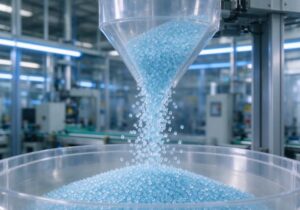
Why Long-Term Clarity Depends on Formulation, Not Just Resin
The Degradation Pathway That Turns Transparent PVC Yellow
The base PVC resin provides the foundation for clarity, but the long-term performance of прозрачные гранулы ПВХ depends heavily on the stabilization and additive system.
PVC degradation follows a well-understood pathway. When exposed to heat or UV radiation, labile chlorine atoms can be released from the polymer backbone, initiating dehydrochlorination. This produces conjugated double bonds, or polyene sequences, that absorb visible light and cause progressive discoloration. In a transparent PVC compound, this degradation may gradually shift the material from clear to yellow and, under more severe conditions, toward darker colors.
A suitable stabilizer system helps slow this degradation while maintaining the optical properties required for прозрачные гранулы ПВХ. Different stabilizer chemistries, however, provide different levels of thermal stability, color retention, and compatibility with clear PVC formulations.
Stabilizer Systems and Their Impact on Optical Quality
| Stabilizer Type | Clarity Retention | Typical Use Case | Key Considerations |
|---|---|---|---|
| Organotin (methyltin, octyltin) | Отличная | Rigid clear sheets, bottles, profiles | Regulatory requirements vary by application and market |
| Calcium-zinc (Ca/Zn) | Good to excellent | Medical tubing, food packaging, toys | Co-stabilizer and lubricant selection is important |
| Barium-zinc (Ba/Zn) | Application-dependent | Flexible PVC applications | Regulatory suitability varies by market and end use |
| Lead-based | Generally unsuitable for clear applications | Legacy PVC products | Restricted or prohibited in many applications |
| Epoxidized soybean oil (ESBO) | Useful as a co-stabilizer | Flexible films and other PVC products | Normally used as part of a broader stabilization system |
Organotin stabilizers are widely used where high optical clarity and color stability are required in rigid PVC. Calcium-zinc systems are also used for applications with specific regulatory requirements, but their performance depends on the complete stabilizer, co-stabilizer, and lubricant package.
For прозрачные гранулы ПВХ, stabilizer selection should therefore be considered together with the intended application, processing conditions, regulatory requirements, and required service life.
The Critical Role of UV Stabilizers
Heat stabilizers primarily protect transparent PVC compounds during processing and thermal exposure, while UV stabilizers help limit degradation caused by sunlight.
Outdoor exposure can gradually reduce the optical stability of clear PVC. UV radiation can initiate photo-degradation, while an incompatible UV additive may contribute to surface migration, blooming, or haze.
Two common approaches are:
УФ-абсорберы absorb part of the incoming UV radiation and dissipate the energy as heat. Benzotriazoles and benzophenones are examples used in some polymer formulations. Their compatibility with the PVC matrix is important because poor compatibility can contribute to blooming or surface haze.
Hindered amine light stabilizers (HALS) work through radical-scavenging mechanisms rather than primarily absorbing UV radiation. Their effectiveness depends on the formulation, concentration, exposure conditions, and polymer system.
For outdoor прозрачные гранулы ПВХ, UV absorbers, HALS, or other light-stabilization approaches may be selected according to the required service conditions. UV exposure, wall thickness, formulation, processing, and climate can all affect how well a clear PVC compound maintains its optical performance over time.
Real-World Applications and Performance Requirements for Clear PVC Compounds
Transparent PVC granules are used across medical, construction, automotive, packaging, and industrial applications. However, the required balance of clarity, flexibility, chemical resistance, and durability varies by end use.
Medical Tubing and Fluid Administration
Medical tubing and fluid administration sets require consistent optical clarity for checking fluid levels, particulates, and color changes. Medical-grade transparent PVC granules must also meet application-specific requirements for extractables, leachables, biocompatibility, and regulatory compliance. Ca/Zn stabilization may be used depending on the formulation and intended application.
Rigid Sheets and Retail Displays
Clear rigid sheets, protective barriers, and retail displays require transparent PVC compounds that combine optical clarity with resistance to yellowing, surface deposits, and environmental exposure. Even indoor products may experience UV exposure near windows. Stabilizer and lubricant selection should therefore support both clarity and the required processing conditions.
Automotive and Industrial Components
Automotive and industrial components may face elevated temperatures, UV exposure, and repeated environmental stress. Transparent PVC granules for these applications may require enhanced heat and light stabilization or multilayer constructions. Formulation selection should consider temperature, UV exposure, service life, part thickness, and processing method.
Consumer Packaging and Chemical Contact
Transparent PVC packaging for cosmetics and personal care products must balance clarity with compatibility with the packaged contents. Essential oils, alcohols, and other chemicals can affect PVC through swelling, haze, plasticizer interaction, or surface damage. Transparent PVC granules should therefore be selected according to the actual contents, contact conditions, temperature, and required shelf life.
Industrial sight glasses and flow meters require both transparency and chemical resistance. Where continuous exposure to aggressive chemicals is expected, standard transparent PVC compounds may not be suitable. Specialized formulations, barrier layers, or alternative materials may be considered based on the chemical environment.
Across these applications, the performance of прозрачные гранулы ПВХ depends on more than initial clarity. Formulation, processing conditions, chemical compatibility, UV exposure, and aging requirements should all be considered when selecting a clear PVC material.
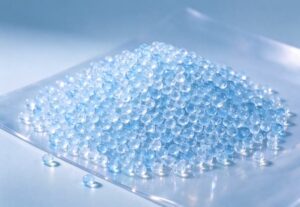
Comparing Transparent PVC Granules with Other Clear Plastics
Buyers often compare transparent PVC with polycarbonate, acrylic, PETG, and other clear plastics. The right material depends on the required balance of optical clarity, UV stability, chemical resistance, cost, and processing requirements.
| Материал | Initial Clarity | УФ-устойчивостью | Химическая устойчивость | Relative Cost | Обработка |
|---|---|---|---|---|---|
| Transparent PVC | Отличная | Good with suitable UV stabilization | Moderate to good | Низкий | Extrusion and injection |
| Polycarbonate | Отличная | Moderate; UV protection may be required | Limited with some solvents | Высокое | Drying typically required |
| Acrylic (PMMA) | Отличная | Отличная | Moderate; depends on chemical | Medium | Good clarity, but more brittle |
| PETG | Very good | Good | Moderate | Medium | Drying typically required |
| Polystyrene | Good | Limited | Limited | Низкий | Relatively easy to process |
Transparent PVC offers a useful balance between clarity, cost, and processing flexibility. Its formulation can be adjusted for rigid or flexible applications, while suitable stabilizers can improve resistance to heat and UV exposure.
Polycarbonate provides high impact strength and optical clarity but may require UV protection for prolonged outdoor exposure. Acrylic generally offers strong outdoor clarity and weatherability, although its brittleness can limit certain applications. PETG provides good clarity and toughness but has different processing and drying requirements.
For buyers, the comparison should focus on the actual service conditions rather than material cost alone. Indoor exposure, UV levels, impact requirements, chemical contact, flexibility, wall thickness, and processing equipment can all affect material selection. Transparent PVC granules can be a practical option when their performance profile matches the application’s requirements.
How to Specify and Process Transparent PVC Granules for Lasting Clarity
Specification Checklist for Buyers
A specification that simply says “clear” is not enough. When sourcing прозрачные гранулы ПВХ, buyers should define the optical, formulation, processing, regulatory, and aging requirements for the intended application.
- Haze and transmittance targets. ASTM D1003 is commonly used to evaluate haze and luminous transmittance. Specify target values together with specimen thickness and test conditions.
- Yellowness index limits. Yellowness index helps monitor color changes in transparent PVC compounds. Define initial limits and acceptable changes after aging according to the application.
- Stabilizer system. Identify the required stabilizer chemistry, such as organotin or Ca/Zn, along with UV stabilization requirements and restrictions on heavy metals or certain plasticizers.
- Processing window. Confirm the recommended processing temperature, residence time, and drying requirements for the прозрачные гранулы ПВХ. These conditions can directly affect final clarity.
- Regulatory compliance. Depending on the end use, requirements may include food-contact regulations, medical-device standards, RoHS, REACH, or other market-specific requirements.
- Accelerated test data. Request relevant weathering or aging data. ASTM G154, ASTM G155, and ISO 4892-2 cover different accelerated exposure methods, so test conditions should be reviewed with the results.
- Outdoor exposure data. For outdoor applications, real-world exposure data from a relevant climate can provide useful evidence alongside laboratory testing.
Processing Tips That Protect Clarity
Even properly formulated прозрачные гранулы ПВХ can lose optical quality through poor processing.
- Dry the material if required. Follow the supplier’s recommendations where applicable, as moisture can contribute to processing defects and haze.
- Control melt temperature. Stay within the recommended processing range and avoid localized overheating that can accelerate PVC degradation.
- Minimize residence time. Excessive residence time increases thermal exposure and can promote discoloration. Purge equipment when required during extended interruptions or material changes.
- Use suitable tooling. Clean and properly maintained molds and dies help maintain surface finish and optical quality.
- Avoid contamination. Prevent colored resin, degraded material, dust, and other contaminants from entering the clear PVC compound.
- Cool uniformly. Controlled cooling can help reduce internal stress and related optical or dimensional defects.
These controls help preserve the clarity and appearance of transparent PVC products during production.
Common Failure Modes to Avoid
Understanding common failure modes helps buyers set realistic specifications for прозрачные гранулы ПВХ and control production risks.
Thermal degradation during processing can occur when PVC experiences excessive temperature or residence time, leading to discoloration and reduced optical quality.
Photodegradation can occur during prolonged UV exposure. Its rate depends on UV intensity, exposure duration, formulation, part thickness, and stabilization, so outdoor performance varies by application and climate.
Plasticizer migration is a consideration for flexible transparent PVC compounds. Some plasticizers can migrate toward the surface and contribute to deposits or changes in appearance. Selection should balance migration resistance, flexibility, compatibility, and optical requirements.
Chemical exposure is application-specific. Alcohols, ketones, aromatic solvents, and other chemicals can affect PVC through swelling, haze, or stress cracking. Compatibility should be evaluated against the actual chemical, concentration, temperature, and exposure time.
Radiation sterilization can affect medical PVC because high-energy radiation may cause polymer degradation or color changes. Medical-grade прозрачные гранулы ПВХ should therefore be validated for the intended sterilization method and dose.
Physical aging may also influence glassy PVC over extended periods. Its effect on optical performance depends on formulation, processing history, and service environment.
Заключение
Transparent PVC granules can maintain long-term clarity when formulation, processing, and service conditions are properly matched. The key is to consider more than initial transparency: heat and UV stability, chemical exposure, plasticizer compatibility, and processing conditions can all affect optical performance over time.
When evaluating suppliers, ask for relevant haze and yellowness data, stabilization details, and aging or weathering results. Choosing the right grade and validating it under actual service conditions can help ensure consistent clarity throughout the product’s intended life. Contact your прозрачные гранулы ПВХ supplier to discuss samples, specifications, and application-specific testing requirements.