
Introduction
You opened a new bearing production line last quarter. The first batch of carriers passed initial assembly. Then two weeks into field testing, the housing cracked.
Or maybe you have seen a different problem. The carrier holds the bearing well enough at room temperature, but once the equipment warms up to 60°C, the fit loosens, and vibration appears. The bearing cage starts drifting inside the housing.
Here is the frustrating part. None of these failures showed up on standard material certificates. The PVC granules you used met the datasheet specifications. But “meeting spec” and “performing in your application” turned out to be two very different things.
So, are you using the right PVC granules for bearing carrier applications? Let’s walk through what actually matters.
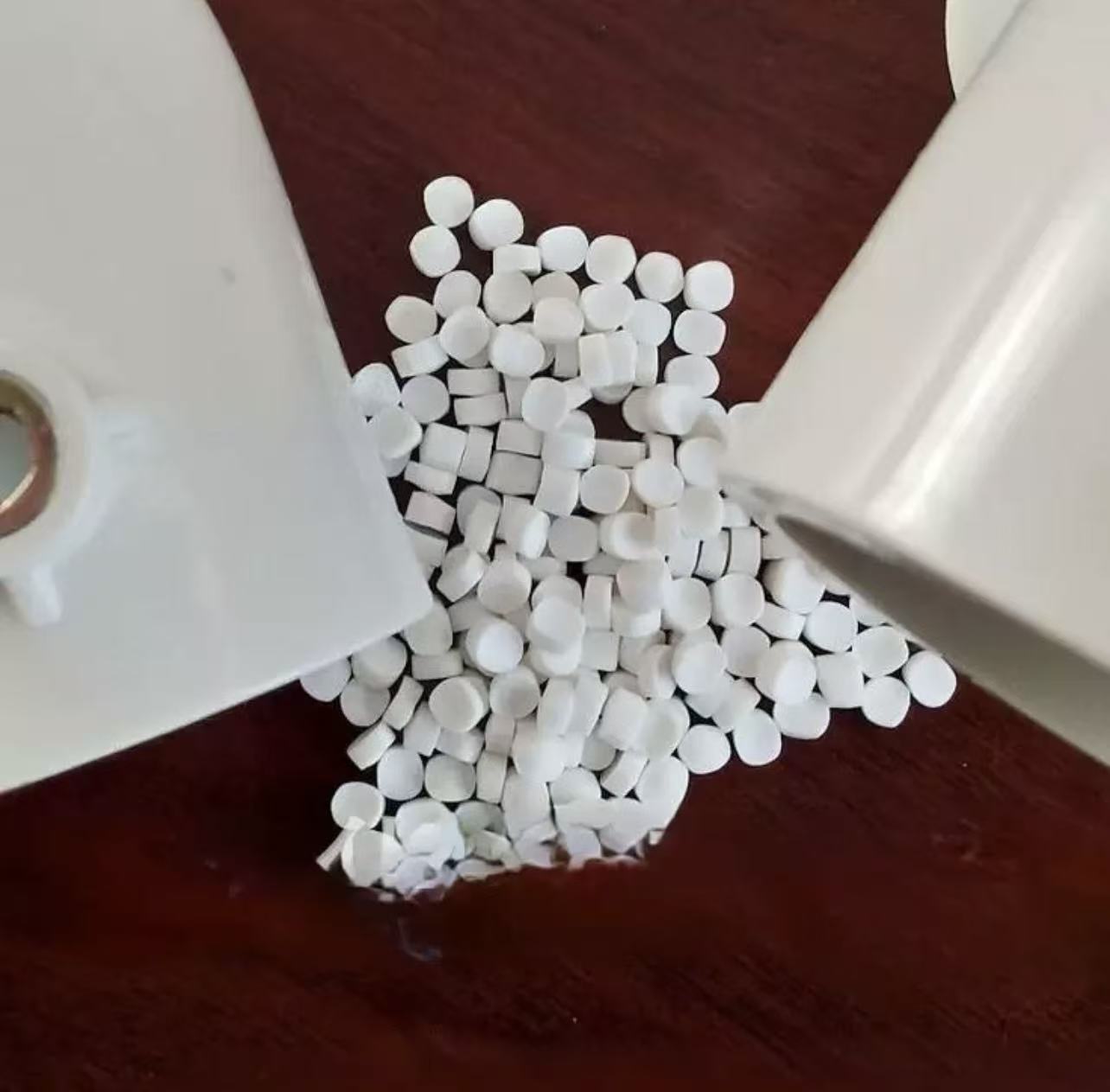
PVC granules for bearing carriers must balance rigidity with toughness
Engineers often make one key mistake with PVC granules for bearing carriers: assuming higher hardness always equals better performance. This is not true.
Rigid PVC-U forms the base of most bearing carrier compounds because it provides inherent strength and stiffness. But if the PVC-U carrier is too rigid, it can:
- Crack under sudden impact loads
- Fail when equipment vibrates during transport or startup
To prevent this, well-designed PVC granules include impact modifiers, typically:
- Acrylic-based (ACR) modifiers – absorb shock and reduce brittleness
- Chlorinated polyethylene (CPE) – improves toughness under mechanical stress
The correct balance is achieved through precise formulation:
- Under-modified compound → too brittle, prone to cracking
- Over-modified compound → loses stiffness, compromises bearing alignment
For most industrial bearing carrier applications, an ISO 180 notched Izod impact strength of≥ 15 kJ/m² is considered acceptable. Below this threshold, cracking under real operating conditions becomes likely.
The right PVC formulation prevents brittle fracture in bearing carriers
Consider this real-world failure:
- A manufacturer used standard rigid PVC granules
- Material passed all quality checks
- After six months in a mining conveyor system, carriers began cracking
The root cause: inadequate thermal stabilization.
- Bearing carriers gradually heat during operation
- Ambient temperature might be 40°C, but friction can raise the carrier to 50–55°C
- Over time, poorly stabilized PVC degrades, causing cracks
Solution: Use modern PVC granules with calcium-zinc (CaZn) stabilizers instead of lead-based systems. Benefits include:
- Long-term thermal stability during injection molding and service
- Prevention of polymer chain breakdown under sustained heat
Key technical checks:
- Heat Deflection Temperature (HDT at 1.8 MPa): ≥ 70°C – ensures material holds shape under heat and load
- Long-term oven aging tests: 1,000–2,000 hours simulate years of service, providing data beyond standard HDT ratings
Bearing carrier wear resistance depends on specialized additive systems
Metal bearing carriers wear down. Plastic carriers can also wear, but the mechanism is different and requires different additive solutions.
In a bearing assembly, the carrier or cage separates the rolling elements and prevents them from contacting each other. The carrier itself experiences contact with the rolling elements. If the material wears too quickly, pockets enlarge, ball spacing becomes inconsistent, and the bearing fails.
Wear performance for PVC granules for bearing carriers is typically measured using the Taber abrasion test (ISO 9352 or similar). Acceptable volume loss for carrier applications is 80 mm³ or less. Exceeding that means the material is shedding particles into the bearing cavity, which accelerates overall bearing failure.
Certain PVC compounds can incorporate specialized wear-resistant additives directly into the polymer matrix. These additives serve two functions:
-
They increase the surface hardness of the finished carrier, reducing abrasive wear from rolling elements.
-
They lower the coefficient of friction between the carrier and the bearing components, which reduces heat generation at the contact points.
The coefficient of friction for the finished carrier can be optimized for different applications. A lower friction value is beneficial for high-speed applications where heat reduction is critical. A slightly higher friction value may be useful in applications where the carrier needs to maintain a secure interference fit with the bearing outer ring.
PVC granules for bearing carriers must meet strict dimensional stability standards
Here is a problem that appears only after the bearing is fully assembled. The PVC carrier passes all raw material tests. The injection molding process produces parts that look correct. But three months later, the customer reports that the bearing is no longer running true.
The cause is often dimensional instability — the carrier is slowly changing shape over time. This happens because the PVC granules used either contained excessive internal stress from molding or lacked the necessary additives to lock in dimensions under real-world conditions.
Dimensional stability for PVC granules for bearing carriers depends on three factors:
-
Residual stress management in the molding process. Carriers with high molded-in stress will relax over time, distorting the bearing pocket geometry.
-
Moisture absorption control. PVC has lower moisture absorption than nylon — typically below 0.1 percent — but uncontrolled absorption still causes swelling.
-
Coefficient of linear thermal expansion matching. The standard CLTE value for rigid PVC is approximately 7 x 10⁻⁵ /K. This means a 100 mm carrier expands by about 0.07 mm for every 10°C temperature rise. That expansion must be accounted for in the interference fit design.
Well-designed PVC granules for bearing carriers use mineral fillers or special additive systems to improve dimensional stability without sacrificing other mechanical properties. The CLTE should be specified on the technical datasheet, and it should be tested at multiple temperature points — not just at room temperature.
How PVC granules compare to other bearing carrier materials
PVC is not the only polymer option for bearing carriers. Polyamide 66 (nylon) and POM (acetal) are also widely used. Each material has distinct advantages and limitations.
The global plastic bearing cage market — which includes carriers for ball bearings, roller bearings, and specialty bearings — is currently valued between 1.1 billion USD and 2.0 billion USD, with tens of billions of units produced annually. PA66 (nylon) is the most common material, often reinforced with glass fibers for enhanced structural rigidity and thermal stability. POM is preferred for high-speed, low-noise applications.
So where does PVC fit in this landscape?
PVC offers unique advantages for bearing carriers that nylon and POM cannot match. PVC provides excellent chemical resistance — particularly to acids, alkalis, and salt solutions — which makes it superior for marine, chemical plant, and agricultural applications. PVC also has significantly lower material cost than nylon, and its processing economics are favorable for high-volume injection molding.
However, PVC has a lower maximum continuous operating temperature. Unplasticized PVC (PVC-U) is typically rated for continuous use up to 60°C, while PA66 can operate up to 100–120°C. PVC also has lower impact strength than impact-modified nylon grades, though proper compounding can narrow this gap.
The table below compares the key material properties across the three polymer options:
| Property | PVC-U | PA66 (Unfilled) | POM (Homopolymer) |
|---|---|---|---|
| Tensile strength (MPa) | 50–60 | 70–85 | 60–70 |
| Flexural modulus (MPa) | 2,500–3,000 | 2,500–3,200 | 2,600–3,100 |
| Notched Izod impact (kJ/m²) | 15–25 | 40–70 | 6–10 |
| Max continuous temp (°C) | 60 | 100–120 | 90–110 |
| Moisture absorption (%) | <0.1 | 1.5–2.5 | <0.3 |
| Chemical resistance | Отличная | Moderate | Good |
| Relative cost | Низкий | Moderate | Low–Moderate |
The selection among these materials depends entirely on your operating conditions. For high-temperature applications above 70°C, nylon is the better choice. For applications requiring superior chemical resistance and the lowest cost, PVC is often the winner.
Real-world bearing carrier applications demand tailored PVC compounds
Let me give you three examples of where correctly formulated PVC granules for bearing carriers make the difference between success and failure.
Marine winch bearings. Saltwater exposure causes rapid corrosion of metal carriers. Nylon carriers absorb moisture and swell, which changes the bearing fit over time. Properly formulated PVC granules for bearing carriers combine seawater resistance (PVC itself is naturally corrosion-resistant) with dimensional stability. The low moisture absorption of PVC — typically below 0.1 percent — means the carrier does not swell or shrink with humidity changes.
Food processing equipment. Bearings in food plants must resist wash-down chemicals, cleaning agents, and high-pressure steam cleaning. PVC carriers formulated with food-contact-safe stabilizers meet regulatory requirements while providing the necessary chemical resistance. Calcium-zinc stabilization systems are essential here — they are non-toxic and comply with food contact regulations.
Agricultural machinery. Combine harvesters and tractors operate in dusty, abrasive environments. The bearing carriers must resist particulate ingress while handling shock loads from uneven terrain. PVC granules for bearing carriers in agricultural applications typically use higher levels of impact modifiers (either ACR or CPE) to absorb the mechanical shocks of field operation while maintaining wear resistance against abrasive dust.
Five critical checks before you specify PVC granules for bearing carriers
You have read the theory. Now here is your practical checklist for evaluating PVC granules for bearing carriers.
Check One: Confirm the PVC base type. Unplasticized PVC (PVC-U) is required for bearing carriers. Plasticized PVC (flexible PVC) is too soft and will not maintain bearing alignment. The supplier should explicitly state “rigid PVC” or “PVC-U” on the specification sheet.
Check Two: Review the impact modification level. Request notched Izod impact test data. For general industrial bearing carriers, target ≥15 kJ/m². For agricultural or mining applications with high shock loads, higher values may be required.
Check Three: Verify the stabilization system. Calcium-zinc (CaZn) is the industry standard for modern PVC granules for bearing carriers. Avoid lead-based stabilizers, which are being phased out globally and may create supply chain or compliance issues.
Check Four: Examine wear test data. Ask for Taber abrasion results. Acceptable volume loss for bearing carrier applications is ≤80 mm³. If the supplier cannot provide this data, request a sample for your own testing.
Check Five: Review the coefficient of thermal expansion (CLTE). This should be specified on the datasheet. For a typical PVC bearing carrier application, CLTE values around 7 x 10⁻⁵ /K are standard. If the CLTE is not specified, the supplier may not have tested for it — that is a red flag.
The right PVC granules for bearing carriers pay for themselves
Here is the truth that many buyers learn the hard way. Saving a few cents per kilogram on PVC granules for bearing carriers is not a savings at all when your customer starts rejecting parts for premature wear, dimensional instability, or field failures.
The global plastic bearing cage market is expanding at a compound annual growth rate of approximately 8 percent, driven by industrial automation and the electrification of transport. As more manufacturers convert from metal to plastic carriers, the gap between “cheap PVC” and “properly formulated PVC” becomes wider.
Properly designed PVC granules for bearing carriers deliver:
-
Lower rejection rates in injection molding (better melt flow and thermal stability)
-
Longer service life in corrosive and wet environments (PVC’s inherent chemical resistance)
-
Consistent dimensional accuracy over time (low moisture absorption and proper stabilization)
-
Competitive total cost compared to nylon alternatives
The formulation matters. The testing matters. And the supplier’s ability to provide real data — not just a marketing datasheet — matters.
Заключение
PVC granules for bearing carriers must balance rigidity, impact resistance, thermal stability, and wear performance. You’ve compared PVC to nylon and POM and learned how to evaluate suppliers with a five-point checklist.
The real question is no longer “are you using PVC?” — it’s “are you using the right PVC?”
Visit the PVC Granules for Bearing Carrier product page to review technical specifications, request test data, and discuss your application requirements with the formulation team. Don’t let another batch of cracked or warped carriers reach your customer — the right material exists, and it starts with specifying it correctly.