
Soft PVC granules can replace TPE in many flexible extrusion applications, including cable jacketing, garden hoses, and general-purpose profiles, particularly when cost efficiency and compatibility with existing processing equipment are priorities. However, TPE may be a better choice for components that require repeated flexing, reliable flexibility at low temperatures, or compliance with specific halogen-free requirements. The best material depends on the application, operating conditions, regulatory requirements, and total production cost. Before switching materials, manufacturers should compare the properties of the specific soft PVC compound and TPE grade under their intended processing and service conditions.
The Fundamental Difference Between Soft PVC and TPE
Soft PVC and thermoplastic elastomers (TPE) differ in how they achieve flexibility, and this difference affects their formulation, processing, and end-use performance.
How Soft PVC Granules Are Formulated
Soft PVC granules are compounded from PVC resin, plasticizers, heat stabilizers, and, depending on the application, fillers and colorants. Unlike rigid PVC, which retains its hardness without plasticizers, flexible PVC typically relies on plasticizers to achieve the desired softness and flexibility. The type and amount of plasticizer influence hardness, low-temperature flexibility, migration resistance, and suitability for specific applications.
Common plasticizers include phthalates such as DINP and DEHP, while non-phthalate alternatives such as DOTP are also used. The appropriate formulation depends on the required mechanical properties, processing conditions, and regulatory requirements of the target market.
How TPE Achieves Flexibility
Thermoplastic elastomers combine rubber-like elasticity with the melt processability of thermoplastics. Unlike conventional flexible PVC formulations, many TPE grades can achieve their required flexibility without relying on traditional PVC-type plasticizers. Styrenic TPEs, including SEBS- and SBS-based compounds, are commonly used in flexible extrusion and may contain polypropylene, processing oils, and other additives to achieve specific hardness and performance targets.
TPE can generally be softened by heating and reshaped through thermoplastic processing, although its processing window depends on the polymer type and formulation. These differences in material composition help explain why soft PVC compounds and TPE grades can perform differently in extrusion, flexibility, durability, and regulatory compliance.
Performance Comparison for Flexible Extrusion
When comparing soft PVC granules with styrenic TPE for flexible extrusion, manufacturers should consider density, hardness, temperature resistance, flexibility, and processing requirements. Actual performance varies by compound formulation and grade, so the following comparison should be treated as a general guide rather than a specification for every material.
Key Property Differences at a Glance
| Tính Chất | Soft PVC Compounds | Styrenic TPE (SEBS-Based) |
|---|---|---|
| Mật độ | Formulation-dependent; generally higher | Formulation-dependent; generally lower |
| Hardness | Available in a range of Shore A grades | Available in a range of Shore A grades |
| Temperature resistance | Depends on plasticizer and stabilizer system | Depends on polymer composition and formulation |
| Flex fatigue resistance | Varies with formulation and test conditions | Varies with formulation and test conditions |
| Elongation at break | Grade-dependent | Grade-dependent |
| Regrind suitability | Depends on material condition and quality requirements | Depends on material condition and quality requirements |
| Plasticizer requirements | Typically uses plasticizers to achieve flexibility | Many grades achieve flexibility without conventional PVC plasticizers |
Where Soft PVC Performs Well
Soft PVC compounds are widely used in flexible extrusion applications that require a balance of flexibility, mechanical performance, and cost efficiency. Cable jacketing is one established application, where the compound must meet the cable’s specified electrical, mechanical, flame-retardancy, and temperature requirements. Suitability for a particular voltage rating depends on the complete cable design, applicable standards, and the properties of the selected compound.
Soft PVC granules are also used for garden hoses, window and door seals, furniture edge profiles, and general-purpose tubing. In these applications, the required performance can often be achieved with a properly formulated PVC compound at a competitive material cost. PVC extrusion also benefits from established manufacturing practices and broad industry experience. However, screw design, temperature settings, and processing conditions should be matched to the specific compound rather than assumed to be interchangeable across all PVC grades.
Where TPE Has an Advantage
Styrenic TPE grades may be preferable when an extruded component requires repeated flexing, reliable low-temperature flexibility, or a formulation designed to meet specific material restrictions.
Flex fatigue performance depends on the polymer grade, hardness, specimen geometry, and test method. Some SEBS-based TPE compounds are suitable for demanding dynamic applications, including flexible cable components and selected automotive profiles. Soft PVC can also be engineered for flexible applications, but its performance should be evaluated against the actual bending frequency, operating environment, and expected service life.
Low-temperature flexibility is another important selection factor. Some TPE grades retain flexibility at lower temperatures than conventional soft PVC compounds, while PVC performance depends strongly on its plasticizer system and formulation. For outdoor equipment, refrigerated environments, and cold-climate applications, manufacturers should verify the specified service-temperature range of the exact grade.
TPE grades can also simplify formulation choices when a product requires no conventional PVC plasticizers. However, plasticizer-free, halogen-free, food-contact, or medical suitability should never be assumed from the TPE designation alone. The specific formulation and its supporting compliance documentation must be checked against the intended application and target-market requirements.
Cost: Beyond the Per-Kilogram Price
Soft PVC Granules generally cost less per kilogram than many TPE grades, although the actual price difference depends on formulation, supplier, and order volume. However, material price alone does not determine the final cost of an extruded component.
Density, Regrind, and Line Speed
Several factors affect the cost per part:
- Density. Some TPE formulations are less dense than Soft PVC Granules, potentially reducing material weight for profiles with identical dimensions. The difference depends on the grades being compared.
- Regrind recovery. Both materials may allow production scrap to be reused, depending on contamination, material condition, and product specifications. Actual reuse rates should be verified through production trials.
- Processing speed. TPE throughput depends on melt flow, cooling requirements, die design, and equipment settings. Some grades may support higher line speeds, but this advantage must be confirmed under actual production conditions.
Compliance Overhead and Total Cost
Soft PVC Granules may require plasticizer screening, material declarations, and verification against applicable REACH and RoHS requirements. Testing and reformulation can add costs if a compound fails a customer specification or applicable restriction.
For high-volume parts where cost is a priority, Soft PVC Granules may remain the more economical choice when the selected compound meets all requirements. For applications requiring repeated flexing, low-temperature performance, or documented phthalate or halogen restrictions, a suitable TPE grade may justify its higher material price. Compare total costs, including material consumption, processing, scrap recovery, and compliance.
Regulatory Pressures That Favor TPE
Regulatory requirements can influence the choice between Soft PVC Granules and TPE, particularly for products containing plasticizers. However, compliance depends on the specific formulation and application.
Phthalate Restrictions and REACH
Certain phthalates are restricted under EU REACH legislation for specified uses. Manufacturers exporting products made with Soft PVC Granules to Europe should check the requirements relevant to their product category and obtain appropriate supplier declarations or test reports.
Not all PVC compounds face the same restrictions. Compliance depends on the plasticizer system, intended use, and applicable regulations, so manufacturers should verify the specific formulation rather than assume that all PVC materials carry the same risk.
Non-Phthalate PVC as a Middle Path
Non-phthalate plasticizers such as DOTP offer an alternative for manufacturers seeking to reduce reliance on certain phthalates while retaining flexible PVC’s processing characteristics. Soft PVC Granules formulated with these plasticizers may suit applications with specific material requirements, depending on the formulation and applicable regulations.
However, non-phthalate formulations do not automatically meet every REACH or RoHS requirement or guarantee food-contact or medical suitability. Documentation and testing may still be necessary, and these compounds may cost more than conventional alternatives.
Some TPE grades are available without conventional PVC plasticizers and in halogen-free formulations. These grades may suit applications with specific chemical restrictions, but buyers should verify the exact composition and compliance documentation rather than assume all TPE is plasticizer-free or halogen-free.
Processing Differences on the Extrusion Line
Soft PVC Granules and TPE can both be extruded, but switching materials may require adjustments to temperature settings, screw configuration, cooling, and cleaning procedures. Compatibility depends on the specific compound and equipment.
Temperature Windows and Screw Design
Soft PVC Granules are generally processed at lower temperatures than many styrenic TPE grades. The appropriate settings depend on formulation, hardness, stabilizer system, and residence time. Excessive heat or prolonged residence time can degrade PVC, causing discoloration and potentially releasing hydrogen chloride (HCl). Follow the compound supplier’s recommended processing conditions.
Styrenic TPE grades often require higher temperatures, but their processing windows also vary by formulation. Excessive shear or residence time can affect material stability and product quality. Screw geometry and compression ratio should match the compound’s flow characteristics and the required output; no single screw design suits every PVC and TPE grade.
Output Recalibration When Switching Materials
When switching between Soft PVC Granules and TPE, manufacturers may need to adjust screw speed, temperature, cooling, and haul-off speed to maintain dimensional consistency. Differences in density and melt flow can affect output by weight and volumetric throughput.
Production trials should confirm output stability, profile dimensions, and surface quality before full-scale manufacturing. A validated processing profile for each material is more reliable than transferring settings directly between compounds.
Application-by-Application Guide
Choosing between Soft PVC Granules and TPE depends on the application, operating conditions, and required material properties. The following guide outlines key considerations for common extrusion applications.
Wire and Cable Jacketing
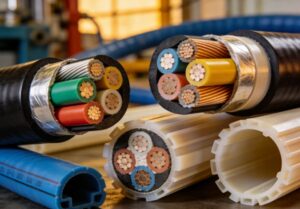
Soft PVC Granules are widely used in wire and cable jacketing because they offer formulation flexibility, electrical properties, and cost advantages. Suitability for a particular voltage rating depends on the complete cable design, applicable standards, and compound specifications. For cables exposed to repeated flexing, such as those used in robotics and automation, selected TPE grades may offer better flex fatigue performance.
Garden Hoses and General Tubing
Soft PVC Granules are commonly used for garden hoses and general-purpose tubing because they combine flexibility with competitive material costs. TPE may be worth considering when an application requires specific low-temperature performance, weather resistance, or documented food-contact suitability.
Automotive Seals and Profiles
Both Soft PVC Granules and TPE are used in automotive profiles and sealing components. Soft PVC may suit interior trim and applications with moderate temperature requirements, while TPE grades, including thermoplastic vulcanizates (TPVs), are often selected for exterior weather seals and components exposed to temperature changes or repeated compression. The appropriate choice depends on durability, compression set, and operating conditions.
Medical Tubing
Soft PVC tubing is widely used in medical applications where clarity and flexibility are important, while selected TPE grades are used in applications requiring specific flexibility, chemical compatibility, or plasticizer restrictions. Neither material is automatically suitable for medical use; the finished product must meet the applicable requirements for its intended application. Material selection should consider biocompatibility, sterilization methods, fluid compatibility, and relevant regulatory documentation.
Window and Door Seals
Soft PVC Granules are commonly used for window and door profiles where cost efficiency and weather sealing are priorities. For applications exposed to low temperatures or repeated compression, suitable TPE grades may offer advantages in flexibility and compression set resistance. Actual performance depends on the formulation and environmental conditions.
Food-Contact Extrusion Profiles
Both flexible PVC and TPE can be formulated for specific food-contact applications, but compliance must be verified for the exact grade and intended conditions of use. Some Soft PVC Granules use non-phthalate plasticizers, while selected TPE grades may avoid conventional PVC plasticizers. Neither material automatically eliminates migration risks or guarantees compliance. Manufacturers should check applicable food-contact requirements, migration test results, and supplier documentation before selecting a compound.
How to Make the Selection Decision
For engineers and procurement teams comparing Soft PVC Granules with TPE, the following checklist helps identify the most suitable material for a specific extrusion application.
Six Factors to Evaluate
- Flex fatigue requirement. For parts exposed to repeated bending, compare the fatigue performance of specific grades under representative test conditions. Selected TPE grades may be preferable for demanding dynamic applications.
- Temperature exposure. Evaluate the required continuous service temperature and low-temperature flexibility. Soft PVC performance depends on its formulation, while suitable TPE grades may offer advantages under specific temperature conditions.
- Regulatory destination. Products intended for EU medical, food-contact, or children’s applications may face specific chemical and material requirements. Verify the applicable regulations and documentation for the finished product.
- Volume and cost sensitivity. For high-volume parts with moderate performance requirements, Soft PVC Granules may offer a cost advantage. Compare total production costs rather than purchase price alone.
- Processing infrastructure. Existing PVC extrusion equipment may accommodate some TPE grades, but switching materials can require processing trials, equipment adjustments, and output recalibration.
- Scrap and regrind economics. Both materials may allow production scrap to be reused. Evaluate the practical recovery rate, material quality, and effect on finished-part performance before estimating cost savings.
When Soft PVC Is the Better Choice
Soft PVC Granules are often suitable for high-volume static or low-flex components, cost-sensitive products, and applications where the selected compound meets the required temperature, mechanical, and regulatory specifications. Existing PVC processing infrastructure may also help reduce switching costs.
When TPE Is the Better Choice
TPE may be preferable for demanding repeated-flex applications, specific low- or high-temperature requirements, or products requiring documented halogen-free or phthalate-free formulations. The decision should be based on the performance and compliance of the selected grade, balanced against material price, processing costs, and long-term service requirements.
What to Verify Before Switching
If you are considering replacing TPE with Soft PVC Granules, or the reverse, do not rely on datasheet specifications alone. Material performance varies by grade and compound formulation, so testing under actual production conditions is essential.
Samples, Tooling, and Total Cost per Meter
Before committing to a material switch, verify:
- Hardness and modulus at your target durometer. Soft PVC Granules and TPE with the same Shore A hardness may still differ in stiffness, flexibility, and extrusion behavior.
- Compatibility with your die and downstream equipment. Differences in melt rheology, shrinkage, and cooling behavior may require adjustments to tooling or processing settings.
- Regulatory documentation for your specific grade. Confirm that the selected compound meets the requirements for your target market and intended application.
- Total cost per finished meter, not per kilogram. Consider material density, scrap recovery, line speed, and production yield when comparing Soft PVC Granules with TPE.
Kết luận
Soft PVC Granules can replace TPE in many flexible extrusion applications, but the right choice depends on performance requirements, operating conditions, and total cost. Soft PVC offers cost efficiency and established processing methods, while suitable TPE grades may provide advantages in repeated flexing, low-temperature flexibility, or specific material compliance requirements. Non-phthalate PVC compounds can also offer an alternative for applications with particular plasticizer restrictions.
Before switching materials, compare the required temperature range, flexibility, regulatory requirements, and production costs. If you are evaluating Soft PVC Granules for cable jacketing, hoses, profiles, or general-purpose extrusion, explore our PVC compound options and request samples to assess their suitability for your application.