
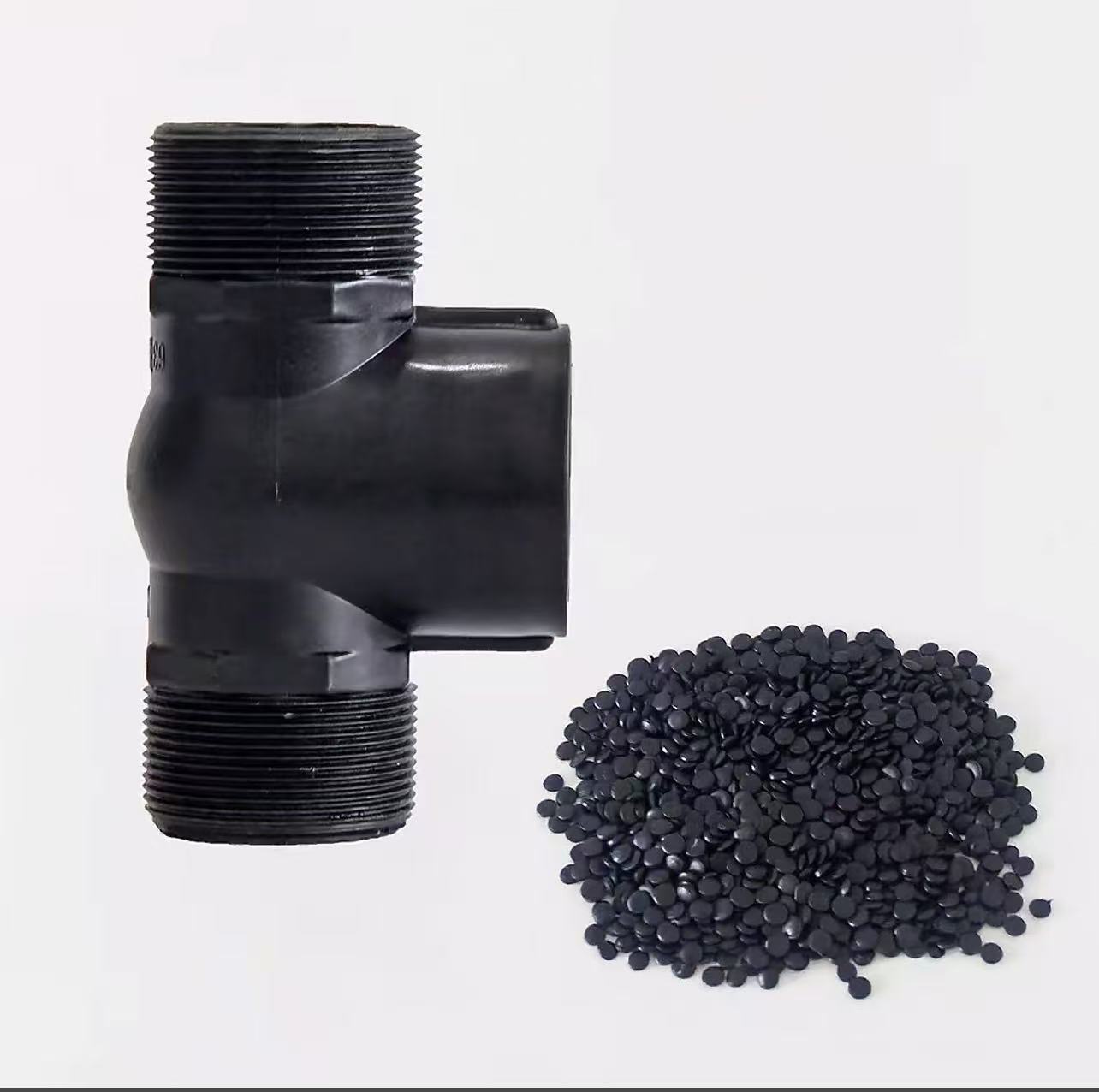

1. PVC Downcomer Pipe Manufacturing Process
The manufacturing of PVC downcomer pipes (a type of rigid PVC pipe) primarily uses the Extrusion Process. It is a highly automated and continuous operation, consisting of the following key stages:
Step 1: Mixing & Compounding
-
Raw materials, primarily Suspension PVC (S-PVC) resin, are blended with additives (stabilizers, lubricants, processing aids, impact modifiers, fillers, and pigments) in a high-speed mixer. This creates a homogeneous dry blend.
Step 2: Melting & Plastification
-
The dry blend is fed into the hopper of an extruder. Inside the extruder barrel, it is heated and sheared by a rotating screw. This process melts and mixes the material into a uniform, viscous melt.
Step 3: Extrusion & Shaping
-
The molten PVC is forced through a specially designed annular die (a ring-shaped die), which gives the material its initial tubular shape.
Step 4: Sizing & Cooling
-
The hot, soft pipe exiting the die immediately enters a sizing sleeve. Here, vacuum or internal pressure is applied to ensure the pipe conforms to the precise required diameter and wall thickness.
-
The pipe then enters a closed cooling tank (or multiple tanks) filled with water, where it solidifies and hardens completely.
Step 5: Pulling & Cutting
-
A haul-off or puller unit grips the cooled pipe and pulls it at a constant speed, synchronizing with the extrusion rate.
-
Once the pipe reaches a set length, an automatic saw or cutter cleanly severs it.
Step 6: Inspection & Packaging
-
The finished pipes are inspected for dimensions, visual defects, and tested for required mechanical properties (like those in your previous table: hardness, tensile strength, etc.).
-
Approved pipes are marked, bundled, and packaged for shipping.
2. PVC Formulation
The PVC formulation (or formula) is the “recipe” that defines the final properties of the product. It is the core technology behind manufacturing different types of PVC. A typical Rigid PVC Pipe Formulation includes the following components:
Product Specification Table
| Item | Test Standard | Parameter / Value |
|---|---|---|
| Hardness | ISO 868:2003 (6mm/23°C) | Shore A 70 |
| Density | ISO 1183:2004 | 0.8 g/cm³ |
| Environmental | RoHS / REACH | Compliant |
| Tensile Strength | ISO 527:1993 | ≥ 13 MPa |
| Elongation at Break | ISO 527:1993 | ≥ 290% |