
Shore A hardness is a useful starting point when selecting soft PVC granules, but it cannot predict every aspect of material performance. Two compounds with similar hardness readings may differ in flexibility, tear resistance, plasticizer retention, and processing behavior. To select a suitable grade, buyers need to match the hardness target to the end application, then verify the formulation, test method, and batch consistency. This guide explains how to evaluate those factors before approving a material for production.
What Shore A Hardness Actually Tells You About Soft PVC Granules
The Shore A Scale and Where It Applies
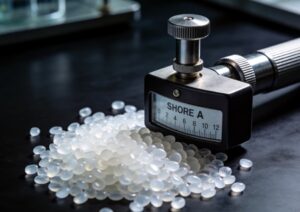
Shore A is commonly used to measure the indentation hardness of flexible PVC compounds and other soft materials. The reading indicates resistance to penetration under specified test conditions; it does not directly measure tensile strength, elongation, tear resistance, or long-term flexibility.
When comparing soft PVC granules, confirm that the quoted hardness is measured on a molded or otherwise prepared specimen using the same durometer scale and a consistent test procedure. Shore A and Shore D readings are not interchangeable. If a supplier provides a hardness value without identifying the scale and test method, request clarification before using it in a purchase specification.
The appropriate hardness range depends on the part’s geometry, flexibility requirements, service temperature, and mechanical loading. A grade intended for a flexible cable jacket may not suit a stiff protective profile, even if both products are made from PVC.
How the Test Method Affects the Reading
ASTM D2240 and ISO 868 describe durometer hardness testing, but their procedures and requirements should not be treated as automatically interchangeable. The selected standard, specimen thickness, surface condition, conditioning, durometer type, and reading procedure can all affect the reported result.
For incoming inspection, specify the applicable test standard and revision, the Shore scale, specimen preparation requirements, and the acceptance tolerance. Use the same procedure when comparing supplier data with your own test results. If the hardness value is measured on a laboratory plaque, do not assume it will be identical to a reading taken directly from a finished part with a different thickness or surface geometry.
Before publishing exact conditioning times, temperature ranges, or specimen dimensions, verify them against the applicable standard and the supplier’s documented test procedure.
Understanding the Limits of Shore A
Shore A results should be interpreted within the measurement range and procedures specified by the applicable test standard. At the very soft or hard ends of a durometer’s working range, the suitability of the scale and test setup deserves particular attention.
A high Shore A reading does not automatically establish that a compound is semi-rigid or suitable for a specific load-bearing application. If a grade is near the upper end of the intended hardness range, verify the appropriate test method and assess impact resistance, flexural behavior, and dimensional stability separately. Choose the scale and acceptance criteria according to the material and the requirements of the finished part.
What a Hardness Number Does Not Describe
Hardness is only one part of a flexible PVC compound’s performance profile. Two grades with similar Shore A readings can differ in tensile strength, elongation at break, tear resistance, compression set, low-temperature flexibility, and plasticizer retention.
These differences depend on the formulation and service conditions, not hardness alone. Use Shore A to narrow the initial material selection, then confirm the properties most relevant to the finished part through technical data, application testing, or both.
Matching Shore A Bands to Common Applications
Soft PVC granules map onto broad hardness bands. The table below reflects common industry conventions, not universal rules; within each band, actual performance still depends on plasticizer type, filler loading, and the service environment.
| Shore A range | General characteristics | Potential applications | Properties to verify |
|---|---|---|---|
| 40–55 | Very soft and highly flexible | Soft tubing, flexible seals, cushioning components | Tear resistance, compression set, plasticizer retention |
| 55–70 | Soft and flexible | General-purpose tubing, flexible hose, selected cable applications | Elongation, low-temperature flexibility, dimensional stability |
| 70–85 | Balanced flexibility and stiffness | Cable jackets, flexible profiles, shoe components | Tensile strength, abrasion resistance, heat ageing |
| 85–95 | Relatively firm, with limited flexibility compared with softer grades | Firm profiles, selected flooring compounds, protective trims | Impact resistance, cracking behavior, suitability of the test scale |
These ranges are illustrative selection guides, not universal product specifications. The appropriate Shore A target depends on the formulation, part geometry, processing method, and service conditions. Confirm the required hardness with application testing and the supplier’s technical data.
Very Soft Bands (Shore A 40–55)
Compounds in this range are designed for applications requiring substantial flexibility and surface compliance. Potential uses include soft tubing, cushioning components, and flexible seals, provided the material meets the relevant mechanical and regulatory requirements.
Before selecting a very soft grade, check tear resistance, compression set, and plasticizer retention. A compound that bends easily may still perform poorly under repeated stretching, sustained compression, or elevated-temperature exposure.
Soft Flexible Bands (Shore A 55–70)
This range may suit flexible hose, general-purpose tubing, mats, and selected cable applications. The final hardness target should reflect how the product will bend, stretch, coil, or remain under load during service.
For components exposed to sustained compression, repeated flexing, or cold temperatures, review compression set and low-temperature performance rather than selecting a grade from hardness alone.
Medium-Soft Bands (Shore A 70–85)
This range can provide a useful balance between flexibility and stiffness in applications such as cable jackets, flexible profiles, shoe components, and protective coverings. However, the same nominal hardness does not guarantee equivalent tensile strength, abrasion resistance, or dimensional stability across different formulations.
For extrusion applications, evaluate surface finish, dimensional consistency, and performance at the intended line speed. For products exposed to heat or repeated bending, verify the relevant ageing and flexibility requirements before approving the compound.
Semi-Rigid Bands (Shore A 85–95)
Compounds at the firmer end of the Shore A range may be suitable for protective trims, relatively stiff profiles, and selected flooring applications. Their actual behavior depends on the resin, plasticizer system, filler loading, and product design.
For applications requiring greater stiffness or impact resistance, confirm that Shore A is an appropriate specification for the material. Evaluate cracking, impact performance, and dimensional stability under the expected service conditions instead of assuming that a higher hardness reading guarantees better durability.
How to Set a Hardness Target for a Specific Application
Start with the finished part’s functional requirements rather than choosing a hardness grade from a general-purpose range.
For cable jackets, consider bending requirements, abrasion exposure, and the applicable electrical and mechanical specifications. For flexible hose, review pressure requirements, coiling behavior, and resistance to the intended service environment. For seals and gaskets, evaluate compression set and recovery under the expected load. For molded components, consider demolding behavior, dimensional stability, and the effect of part thickness.
Once the main requirements are defined, use Shore A hardness to narrow the candidate grades. Confirm the final selection with the supplier’s technical data and a production-representative trial.
Beyond the Number: What Else in the Granule Determines Performance
Soft PVC granules are a formulated product, and hardness is an outcome of that formulation rather than an independent input. Four variables in the granule itself move the number, and each of them matters independently for procurement.
Plasticizer Content and Type
Plasticizers generally reduce the hardness of flexible PVC by increasing chain mobility, but the relationship between plasticizer loading and Shore A hardness depends on the entire formulation. Resin characteristics, plasticizer efficiency, filler content, and other additives can all affect the final result.
Different plasticizers may also differ in volatility, migration resistance, low-temperature performance, and compatibility with the PVC resin. A compound formulated for flexibility at room temperature may not retain the same performance under prolonged heat exposure or contact with oils and other media.
When comparing soft PVC granules from different suppliers, confirm the plasticizer system where it affects performance or regulatory compliance. Do not transfer phr values directly between formulations or assume that equal plasticizer loading will produce equal hardness. Request grade-specific technical data and verify the properties required for the intended application.
Filler Loading and Density
Mineral fillers such as calcium carbonate can affect the density, stiffness, tensile behavior, and processing characteristics of flexible PVC compounds. Their effects depend on filler type, particle characteristics, loading level, and the surrounding formulation.
Density can be a useful quality-control indicator when a grade has an established reference range. If a new lot shows a meaningful density change while hardness remains similar, investigate whether the formulation or material composition has changed. However, density alone cannot identify the cause, so compare it with tensile data, elongation, ash content where applicable, and the approved product specification.
When purchasing soft PVC granules, request a target density and acceptance range only when these values are relevant to the application and can be consistently measured.
Resin Grade and Molecular Weight
PVC resin characteristics, including K-value, influence melt viscosity, fusion behavior, and mechanical properties. These factors can affect how a compound processes during extrusion, injection molding, and calendering.
A resin change may alter processing behavior even when the finished compound meets the same nominal hardness target. When consistency is important, ask the supplier whether the approved resin grade and formulation are controlled between production lots. Confirm processing suitability through technical data and trials under representative production conditions.
Processing Behavior and Hardness
Shore A hardness alone cannot predict melt viscosity, fusion behavior, or the width of a processing window. These characteristics depend on resin grade, plasticizer system, additives, equipment, temperature, and shear conditions.
When selecting soft PVC granules, request processing guidance for the specific grade and manufacturing method. For extrusion, review melt stability and surface quality at the intended output. For injection molding, verify filling behavior, demolding, and shrinkage using representative part geometry. For calendering, confirm fusion behavior and compatibility with the planned roll and cooling conditions.
Treat hardness as one selection parameter and validate processing performance through grade-specific data and production trials.
What to Check When Buying Soft PVC Granules to a Hardness Target
A purchase specification that says only “Shore A 70” leaves too much room for variation. A workable specification for soft PVC granules should include the hardness target, the test method, the acceptable tolerance, and a lot-to-lot consistency expectation.
Hardness Tolerance
Suppliers commonly work to a tolerance band rather than a single number. A ±2 to ±3 Shore A tolerance is a practical range for many general-purpose soft PVC granules, but the acceptable width depends on the application. A thick-profile extrusion may tolerate ±3 A without a visible effect; a thin-wall medical tube or a precision gasket may require tighter control. Ask the supplier to state the tolerance explicitly rather than assuming the nominal value is the centre of a narrow band.
Lot-to-Lot Consistency
Hardness variation between lots is often more damaging than a small offset from the nominal target. A processor who has dialled in drying, melt temperature, and cooling for one lot may see dimensional drift or surface defects when the next lot of soft PVC granules arrives at a different effective hardness. Request lot-specific COA data, not just a generic product datasheet. If the supplier cannot provide hardness values for the actual batch being shipped, the specification is not verifiable.
Reading the COA Correctly
A useful COA should identify the material grade, production lot, test results, and applicable acceptance criteria. Depending on the application, request the following information:
- Shore A hardness, test method, and acceptance limits
- Density, where it is part of the agreed specification
- Tensile strength and elongation at break
- Relevant test conditions and specimen preparation details
- Plasticizer or formulation compliance information, where required
- Ash content or other composition indicators, where specified
- Production lot number and test date
Not every application requires every item. Agree on the required data before ordering, and ensure that the COA reports actual batch results where applicable rather than only typical values from a general product datasheet.
For applications with specific chemical, regulatory, or durability requirements, confirm the relevant material declarations and supporting documentation before approving a grade. Do not rely on hardness or density alone to establish compliance with phthalate restrictions, other substance requirements, or customer-specific standards.
If a formulation change could affect compliance or product performance, agree with the supplier on notification and approval requirements before the material is used in production.
Processing Window and Shrinkage
Ask for a recommended melt temperature range and any shear sensitivity notes. For injection moulding grades of soft PVC granules, also ask how the compound behaves in terms of shrinkage. Flexible PVC shrinkage is typically higher and less linear than rigid PVC, and it varies with hardness, mould temperature, and part thickness. A supplier who cannot discuss this is likely not supporting injection moulders.
Incoming Inspection Checklist
- Confirm the grade and lot number against the purchase order.
- Check hardness against the agreed test method and tolerance.
- Compare density and mechanical properties with the approved specification, where applicable.
- Review the COA and any required material declarations.
- Retain a representative sample when required by the quality procedure.
- Document deviations and obtain approval before using nonconforming material.
Common Selection Errors and How to Avoid Them
Choosing by Hardness Alone
A compound can meet its nominal Shore A target and still fail in service if the actual requirement is tear resistance, low-temperature flexibility, compression recovery, or resistance to ageing. Identify the property responsible for the application requirement before changing the hardness target.
Transferring Formulation Data Between Grades
Plasticizer loading, resin characteristics, and filler content can differ between formulations. Do not assume that the same phr values or nominal hardness will produce equivalent processing behavior when switching suppliers or material grades. Revalidate the material against the approved specification.
Ignoring Test Conditions and Long-Term Performance
Hardness results are meaningful only when the test method and specimen conditions are defined. In addition, initial hardness does not establish long-term resistance to plasticizer migration, volatility, heat ageing, or contact with service media. Verify the properties relevant to the intended environment before approving the grade.
Troubleshooting a Hardness-Related Failure
When a flexible PVC component fails to meet its hardness or performance requirement, investigate the following factors in sequence:
- Confirm the batch hardness result and the applicable test method.
- Compare the COA with the approved grade specification and previous lots.
- Check density and mechanical test data for evidence of material variation.
- Review processing temperatures, cooling conditions, and other relevant production settings.
- Verify the plasticizer system and any formulation changes with the supplier.
- Reassess the actual service conditions if the material passes incoming inspection but fails in use.
Use the findings to identify the cause before changing the hardness target. A formulation change, process adjustment, or additional performance test may be more appropriate than simply selecting a softer or harder grade.
How Hardness Choice Interacts with Processing Method
The same Shore A target can require different soft PVC granules formulations depending on how the part is made.
Extrusion
For extrusion, the selected soft PVC grade must suit the required profile, die design, line speed, and cooling setup. Evaluate melt stability, surface finish, dimensional control, and flexibility in the finished product.
A grade change can affect processing behavior even when the nominal hardness remains the same. Confirm the supplier’s processing recommendations and conduct a representative trial before introducing a new formulation into routine production.
Injection Moulding
Injection moulding places more demands on soft PVC granules than extrusion does. Harder grades fill thin sections more readily but can be more sensitive to gate freeze and warpage; softer grades fill easily but shrink more and may demould poorly. Shrinkage values for flexible PVC typically range higher than for rigid PVC and should be confirmed for the specific grade and part geometry.
Calendering and Coating
Calendering and coating use soft PVC granules formulated for a specific fusion behaviour on the calender train. Hardness affects the roll gap settings and the cooling regime, so a grade change within the same nominal band can still require line adjustments.
Building a Practical Granule Specification
| Specification item | What to define | Why it matters |
|---|---|---|
| Dureza | Shore A target and acceptance tolerance | Defines the required hardness range |
| Test method | Applicable standard and test procedure | Ensures comparable results |
| Mecánico | Target and tolerance, where relevant | Helps monitor material consistency |
| Mechanical properties | Required tensile strength and elongation, where applicable | Verifies application performance |
| Material compliance | Required declarations and supporting documents | Addresses regulatory or customer requirements |
| Processing requirements | Intended process and relevant operating guidance | Supports production validation |
| Lot traceability | Batch identification and COA requirements | Supports quality control and investigation |
A practical specification for soft PVC granules should connect the required hardness to measurable acceptance criteria and the finished product’s performance requirements. Define the test method, tolerance, and relevant mechanical or compliance requirements before requesting quotations.
For critical applications, approve a representative sample and establish a baseline for incoming inspection. This gives both the buyer and supplier a documented reference for evaluating future batches and investigating any deviation during production.
Conclusión
Choosing soft PVC granules requires more than matching a Shore A hardness target. Plasticizer type, mechanical properties, processing requirements, and service conditions all influence material performance.
Dingshengtong provides soft PVC granules for different processing and application needs. Contact the team to discuss your target hardness, technical specifications, and customization requirements to identify a suitable grade for your production.